

1. The Portfolio Construction Challenge
Most long-term portfolios are built around a familiar architecture. Equities are expected to deliver long-term growth, real estate to provide real-asset exposure and income, and fixed income to stabilize returns and preserve liquidity. This model has remained broadly consistent across institutional investors, family offices, and sophisticated private investors because it is simple, widely accepted, and historically associated with strong performance over long horizons.
The model’s effectiveness, however, rests on a critical assumption: that these core asset classes can collectively deliver growth, income, and resilience across a wide range of market conditions.
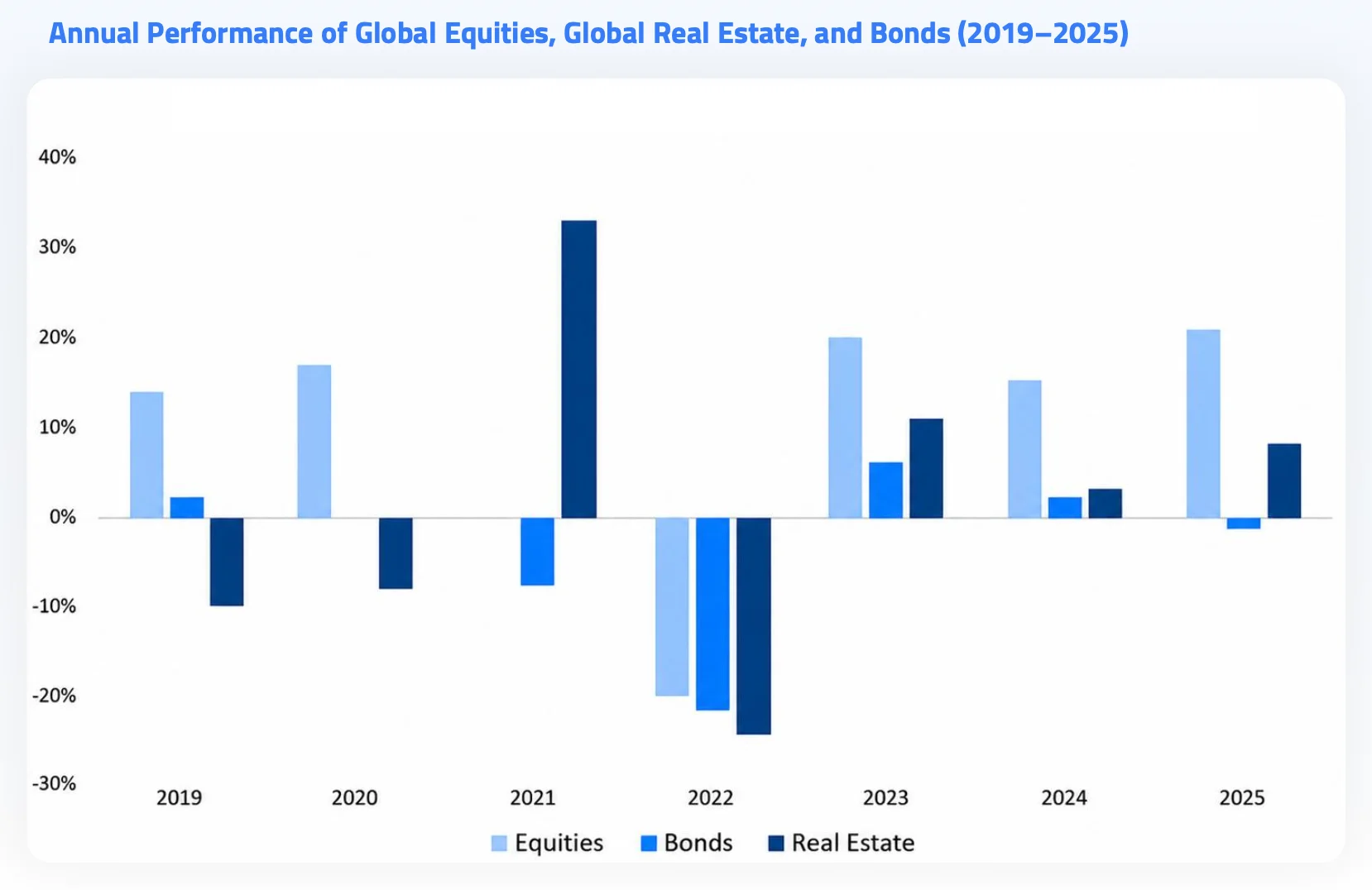
Chart 1: Annual Performance of Global Equities, Global Listed Real Estate, and Bonds (2019–2025 );
Source: FTSE All-World Index historical monthly levels (USD) . Bonds represented by 00785 B bond ETF historical monthly price levels (USD) as a proxy. Global real estate returns based on the FTSE EPRA/NAREIT Global REITs Index (USD) factsheet. Annual returns calculated using December month-end values ; author calculations.
Note: Bond performance is based on a single ETF proxy and may differ materially from broad global bond index returns. Real estate is represented here by listed REITs, which are continuously priced in public markets ; directly held property and appraisal -based vehicles report returns differently, and conclusions drawn from this chart apply to listed real estate specifically.
In practice, this assumption has become less reliable. A portfolio can appear diversified by asset-class label while remaining concentrated in its underlying risk drivers.
Equities and real estate both rely heavily on valuation support. Even when fundamentals remain sound, their performance is mate- rially influenced by discount rates, liquidity conditions, and shifts in risk appetite. When these forces are supportive, returns are amplified ; when conditions tighten, valuation compression can affect multiple port- folio sleeves at once. Diversification, in other words, can weaken precisely when it is most needed.
The stabilizing role of traditional fixed income has also become more complex. Bonds provide contractual cash flows, but their performance is tied to interest -rate dynamics. In environments where inflation pressures rise or monetary policy tightens, bonds can decline alongside equities, reducing their effectiveness as a hedge and increasing the risk that a portfolio’s core allocations draw down at the same time.
Portfolios anchored primarily in equities and real estate therefore tend to perform best in one particular macro regime: stable growth, accommodative financing condi -tions, and supported valuation levels. When investors instead face higher rates, tighter liquidity, and greater macro uncertainty, return generation becomes more dependent on market repricing than on stable cashflow generation.
For many investors, this suggests that traditional allocations may leave certain portfolio objectives underrepresented, chief among them exposure to return streams that accrue primarily through contractual cash flows rather than market-driven appreciation, positioned above equity risk in the capital structure. Income-oriented credit exposure can be obtained through several channels, including public corporate bonds, broadly syndicated loans, private placements, and securitized credit, and many portfolios already hold such exposures. What some portfolios may lack is exposure to privately originated or negotiated credit, where lending terms are set bilaterally rather than in public markets.
Private credit is one potential way to broaden these return drivers. It offers a return stream that is income-driven and contractually defined rather than dependent on market multiples or asset-price inflation . Its potential role is not to replace equities, real estate, or traditional fixed income, but to complement them, and that potential is subject to important qualifications: private credit carries material risks, including illiquidity, credit losses, valuation uncertainty, and wide dispersion of out- comes across managers, and its benefits depend heavily on implementation and market conditions. The argument of this paper is that private credit may be useful for some portfolios, not that it is necessary for any.
The remainder of this paper develops the argument in stages. Section 2 examines why equities and real estate share overlapping vulnerabilities ; Section 3 sets out the characteristics that differentiate private credit and how unevenly they apply across the asset class ; Section 4 considers what those characteristics may, and may not, contribute at the portfolio level ; Section 5 surveys the breadth of the asset class ; Section 6 addresses its risks and limitations ; and Section 7 discusses market context and implementation considerations.
2. The Shared Vulnerabilities of Equities and Real Estate as Core Portfolio Pillars
The potential value of a differentiated allocation becomes clearer when the risk mechanics of equities and real estate are examined more closely. Both remain essential to long-term portfolio construction. Both, however, are fundamentally valuation – sensitive : their performance is influenced not only by underlying cash generation, but by discount rates, liquidity conditions, and shifts in investor sentiment. In certain macro environments, these shared drivers can cause the two asset classes to behave less like diversifiers and more like correlated exposures.
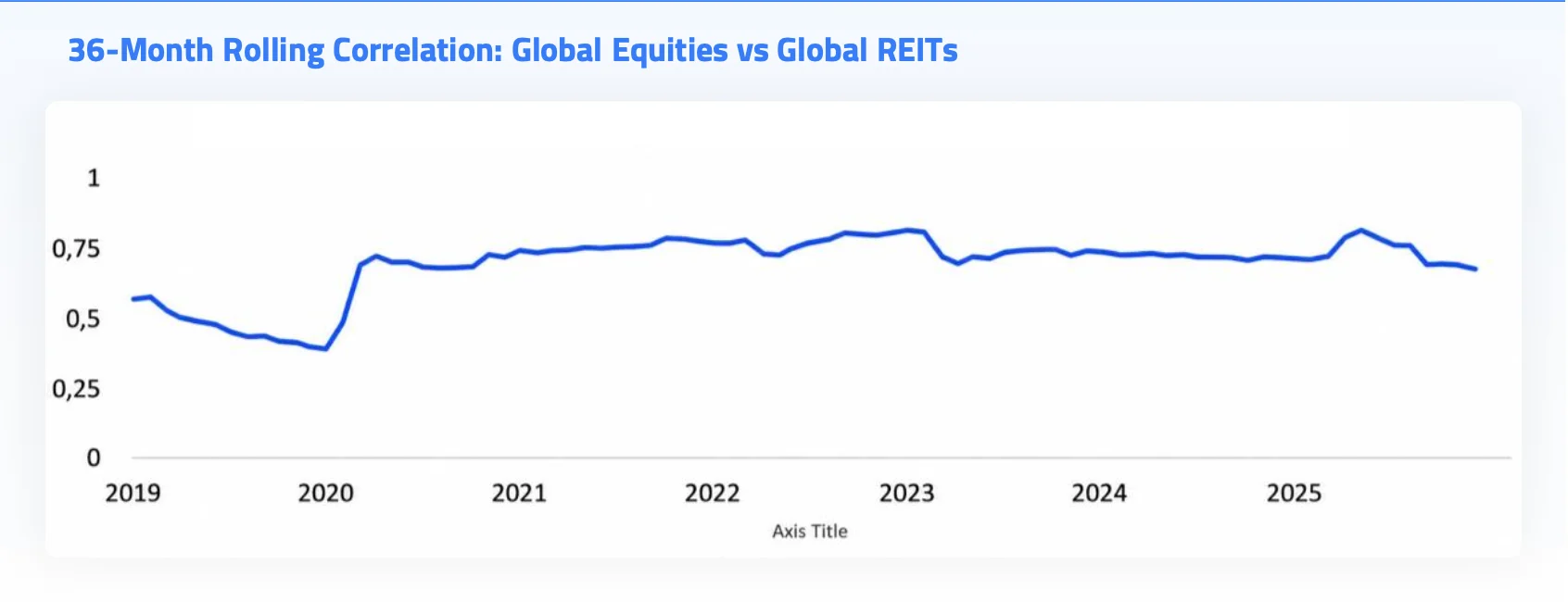
Chart 2: Rolling 36-Month Correlation Between Global Equities and Global Listed Real Estate;
Source: MSCI World Index (USD) and FTSE EPRA Nareit Global REITs Index (USD), historical monthly index levels (Jan 2016 to Dec 2025); author calculations based on monthly returns.
Note: Correlations are calculated between two continuously priced public indices and apply to listed real estate specifically. Correlations measured against private real estate, directly held property, or appraisal-based vehicles would likely appear lower, in part because of appraisal smoothing rather than genuinely independent economics. This measurement effect complicates comparisons between public markets and all privately valued assets, including private credit.
Equities are structurally exposed to re-pricing risk. Even when corporate earnings hold steady, valuations can compress rapidly when the cost of capital rises or risk appetite declines, and public markets transmit these shocks immediately through continuous price discovery. Equity allocations can therefore experience significant drawdowns over short periods, driven as much by macro conditions as by company fundamentals. This volatility is an inherent feature of the asset class, but it creates a dependence on market timing, particularly for investors with liquidity requirements or defined return targets.
Real estate is often perceived as a stabilizing asset because of its tangible nature and income profile, yet its valuation is also highly dependent on financing conditions . When interest rates rise, capitalization rates tend to adjust upward, reducing property values even where rental income remains stable.
Leverage, which is embedded in many real estate structures, amplifies this effect : higher refinancing costs can compress distributions and force asset repricing, particularly in segments with shorter lease durations or higher vacancy sensitivity. These economic dynamics apply to real estate however it is held; what differs is how quickly they appear in reported values : immediately for listed REITs, and with a lag for directly held property and appraisal – based vehicles.
Liquidity adds a further dimension . Directly held real estate is not continuously priced, and transaction activity can decline sharply in stress periods, producing valuation lags that delay the recognition of repricing . Assets may appear stable until liquidity constraints force adjustment, at which point corrections can be abrupt . Illiquidity also reduces portfolio flexibility during downturns, when investors may need to re-balance or access capital. This valuation-lag dynamic is a general feature of privately held and appraisal-valued assets, including private credit and private real estate vehicles alike; its implications for private credit specifically are addressed in Section 6.
The interaction between the two asset classes is the critical point. In tightening cycles, higher rates can compress equity multiples while simultaneously reducing real estate values through cap-rate expansion . In recessionary environments, weaker demand affects corporate earnings and tenant stability at the same time. The correlation evidence in Chart 2 documents this overlap for listed real estate ; for privately held property the same economic linkages exist, even where reported return series obscure them. These overlapping sensitivities reduce the diversification benefit of holding both assets as the portfolio’s primary pillars.
The conclusion is not that either asset class should play a smaller role in long-term portfolios, but that portfolios dominated by the two remain structurally dependent on valuation conditions and financing cycles. This is the context in which privately negotiated, income-oriented credit exposure merits consideration as one option among several for broadening return drivers. The next section examines what differentiates private credit, and how unevenly those characteristics apply across the asset class.
3. What Differentiates Private Credit: Contractual Income, Structure, and Their Limits
Private credit encompasses a broad range of privately originated or negotiated debt exposures : corporate lending, asset-based finance, real estate and infrastructure debt, specialty finance, venture debt, and distresssed or opportunistic strategies, among others . Contractual income is common across much of the asset class, but seniority, collateral, covenant protection, rate structure, liquidity, repayment source, and reliance on current cash interest vary materially by strategy and transaction . The characteristics described in this section should therefore be read as features that appear in different degrees across the asset class, not as universal properties of every private credit exposure.
What unites these exposures is that they are, at their core, lending relationships. Investors provide capital through privately negotiated loans to companies, asset – backed structures, or project -related vehicles, and returns are generated primarily through interest and fees rather than price appreciation . This is the central distinction from the valuation-driven pillars discussed above. Equity investors depend on earnings growth and market sentiment to drive valuation gains ; real estate equity investors depend on rental income together with cap -rate movements and asset repricing ; private credit investors, particularly in income -oriented strategies, earn most of their total return through yield terms agreed at origination.
Contractual income deserves careful characterization. Interest obligations are contractually specified at origination, unlike discretionary equity dividends . They are not, however, immutable : contractual payments may later be amended, waived, deferred, capitalized as payment-in-kind, reduced through restructuring, or impaired by default or liability-management transactions. It is also important to distinguish contractual entitlement from cash realization , accounting income, and ultimate recovery . A loan may accrue income in reported figures while generating little current cash ; entitlements may be renegetiated under stress ; and the amount ultimately recovered may differ from all of these. The predictability of private credit income is therefore conditional on under-writing quality, structure, and the credit environment, not a property of the instrument alone.
The composition of private credit yield also deserves attention, because headline yields are frequently the asset class’s most visible attraction and its most misunderstood statistic. A private loan’s yield typically reflects several components : a base rate or fixed coupon ; a negotiated credit spread compensating for borrower risk; origination and arrangement fees, often received upfront or as original-issue discount ; and incremental compensation for illiquidity, complexity, and the bespoke nature of the transaction . Reported index or fund yields are generally gross figures. Realized investor returns are reduced by management and incentive fees, fund-level financing costs, and credit losses, so the gap between headline yield and net return can be substantial . Comparisons with public credit should be made cautiously : publicly quoted spreads and privately negotiated yields are constructed differently, and the instruments differ in seniority, duration, liquidity, rating coverage, and valuation methodology, so genuinely like-for-like comparisons are rarely available Most importantly, a higher headline yield is not evidence of a superior expected return; it is, in substantial part, compensation for risks and constraints that public instruments do not impose to the same degree, and whether that compensation is adequate varies over time with the balance between capital seeking to lend and borrowers seeking capital.
Position in the capital structure is a second differentiating feature, and one that varies widely. Some private credit is deployed in senior positions with secured claims over assets and cash flows ; other strategies lend on a subordinated basis or against specialized collateral. Where lenders do sit above equity, the borrower’s equity absorbs losses first, while lenders retain repayment rights supported by collateral and legal protections. Seniority improves an investor’s relative position ; it does not guarantee capital protection. Recoveries depend on collateral values at the time of default, documentation quality, enforcement outcomes, and jurisdiction, all of which vary widely. The asset class spans the full capital structure, from senior secured through subordinated instruments, with correspondingly different loss profiles, as discussed in Section 5.
A third feature is negotiated protection . Because transactions are typically agreed directly between lender and borrower, lenders can incorporate financial covenants , reporting requirements, and control rights that support early intervention when performance deteriorates. The extent of these protections varies widely across strategies, transactions, and market cycles : they can be more extensive than in broadly syndicated public credit, but they are not universal, and their strength tends to weaken when competition among lenders intensifies. Negotiated protections improve a lender’s ability to act; they do not provide certainty of recovery.
Finally, rate structures vary across the asset class. Floating-rate coupons, which adjust as benchmark rates move, are common in parts of the market, while other segments lend predominantly at fixed rates. Where present, floating rates reduce the duration exposure that weighs on long-dated fixed income when rates rise, but the protection is specific. Floating rates shift interest-rate risk to the borrower, and higher reference rates raise debt-service burdens, which can increase default risk. Floating-rate structures also mean that income declines when policy rates fall. They mitigate one form of rate sensitivity ; they do not insulate investors from credit risk or from all interest -rate effects.
TAKEN TOGETHER, CONTRACTUAL INCOME, CAPITAL-STRUCTURE POSITION, NEGOTIATED PROTECTIONS, AND RATE STRUCTURE CAN MAKE PRIVATE CREDIT’S RETURN GENERATION STRUCTURALLY DIFFERENT FROM THAT OF EQUITIES AND REAL ESTATE, TO DEGREES THAT DEPEND ON THE STRATEGY AND TRANSACTION.
Whether that difference translates into portfolio-level benefit depends on how the exposure behaves in combination with other assets, and at what cost. The next section considers both.
4. Portfolio-Level Characteristics: Potential Contributions and Their Limits
Private credit’s potential value is best evaluated through portfolio construction rather than standalone returns. Diversification is achieved not by adding asset -class labels, but by combining exposures with genuinely different return drivers . Because much of private credit’s return accrues as interest and fee income, it can be less dependent on exit timing, multiple expansion, or market repricing than equities or real estate . Where this holds, it is a mechanically different source of return, rather than a differently labeled version of the same one.
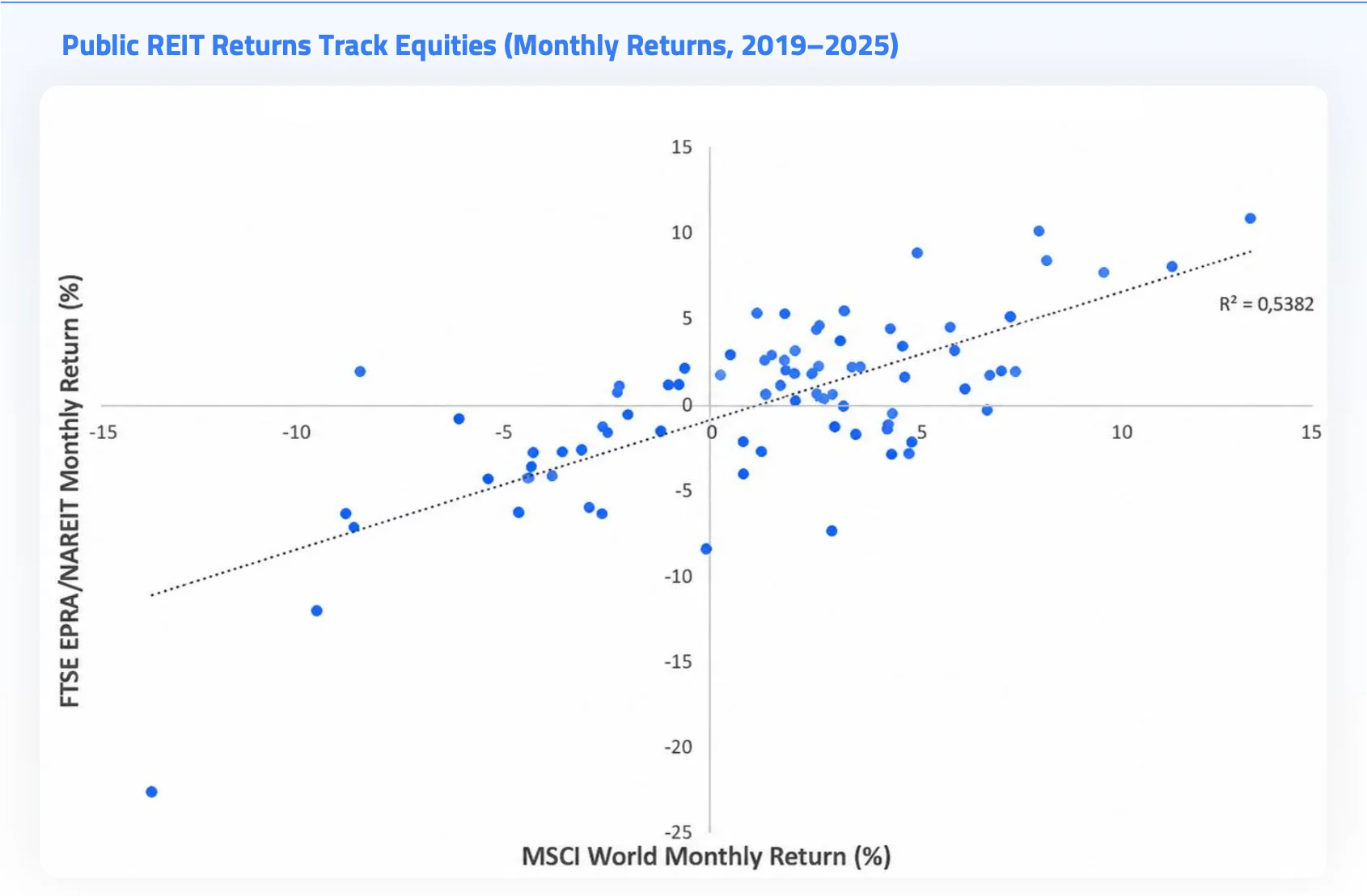
Chart 3: Public REIT Returns Track Equities (Monthly Returns, 2019–2025 );
Source : MSCI World Index and FTSE EPRA/NAREIT Global Index monthly return data; author calculations.
Note: Both series are public, continuously priced indices. The chart illustrates the behavior of listed REITs ; it does not directly measure private real estate, directly held property, or private credit.
Chart 3 illustrates the limits of label -based diversification : listed real estate, priced continuously in public markets, has tracked global equities closely. The evidence concerns listed REITs specifically, and should not be generalized to directly held or privately valued property. What it demonstrates is that public pricing channels can dominate an asset’s short-term behavior regardless of its underlying characteristics.
An income-accruing return stream can behave differently across macro regimes, and this is the basis for private credit’s diversification potential. That potential should not be overstated. Private credit borrowers are exposed to the same real economy as public companies : in a broad downturn, defaults rise as equity markets fall, and the economic correlation between private credit and other risk assets is likely to be higher than reported return correlations suggest.
Income consistency is a further potential contribution, though it is strategy-dependent. Many investors rely on portfolio distributions for reinvestment, liability servicing, or capital planning . Equity dividends can be cut, and real estate distributions can be affected by vacancies, refinancing costs, or capital expenditure cycles. In private credit strategies oriented toward current cash income, interest is contractually specified and typically distributed on a scheduled basis ; other strategies rely more heavily on accrued, deferred, or event-driven returns. Even where income is scheduled, the consistency is conditional : it holds while borrowers perform, and structures that permit interest to be capitalized rather than paid in cash can preserve reported income while masking emerging stress.
Downside behavior can also differ structu – rally. Where lenders hold senior or secured positions, recoveries depend on collateral values and legal enforcement rather than on market sentiment, which may reduce drawdown severity relative to equity-like exposures when underwriting has been disciplined. Losses nonetheless occur, subordinated and weakly collateralized strategies absorb them earlier, and delayed markdowns can defer, rather than avoid, their recognition.
On balance, adding a return stream that accrues contractually has the potential to improve portfolio risk-adjusted outcomes, and investors who can bear illiquidity may earn a premium for doing so. That illiquidity premium is compensation offered for a real constraint, not an assured excess return: its realized size varies with the volume of capital competing to lend, and it can compress when inflows into the asset class are strong. Net outcomes depend on manager selection, entry vintage, strategy, and fees .
Each of these portfolio effects also de- pends on which part of the private credit market an investor accesses. The asset class is broad, and its segments differ materially in risk profile and portfolio function.
5. A Heterogeneous Asset Class: The Private Credit Opportunity Set
Private credit is not a single, uniform exposure. Strategies differ by position in the borrower’s capital structure, the nature and quality of collateral, borrower type, sector, repayment source, and the degree of complexity embedded in transactions. For investors considering private credit as a strategic allocation, understanding this segmentation matters more than any ranking of strategies : each segment embodies a different trade-off among income, structural protection, complexity, and cyclicality, and none is inherently superior to the others . Table 1 summarizes the principal segments in neutral terms ; the paragraphs alphabetical order.
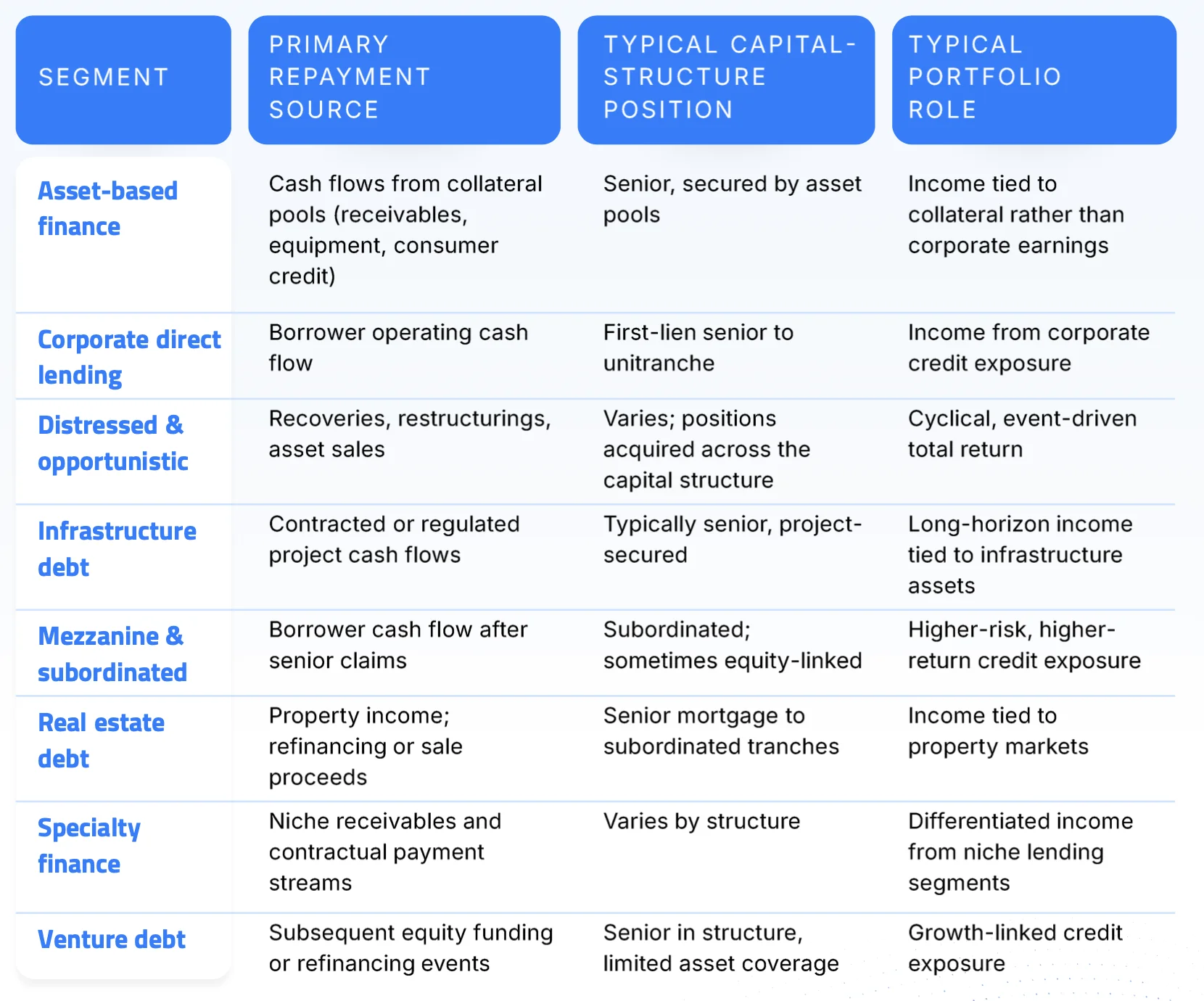
Table 1: An Illustrative Taxonomy of Private Credit Segments
Note: The taxonomy is descriptive and illustrative, not exhaustive ; segments are listed alphabetically . Characteristics shown are typical rather than universal : actual terms, risk, and outcomes vary materially within each segment by transaction, structure, manager, and market cycle . No ranking of attractiveness, safety, or expected return is implied.
Asset-based finance secures lending against specific asset pools, such as receivables, inventory, equipment, or consumer credit portfolios, shifting reliance from corporate earnings to collateral performance. This changes the risk rather than removing it: outcomes depend on collateral quality, servicing capability, and the accuracy of valuation assumptions applied to the underlying pools.
Corporate direct lending provides negotiated loans to operating companies, frequently in the mid-market and often backed by private equity sponsors . Structures range from first-lien senior secured loans, where repayment priority and collateral shape downside outcomes, to unitranche facilities that combine senior and subordinated risk in a single instrument in exchange for a higher spread . Returns across the segment are primarily income-driven, and its principal exposures are corporate credit risk, borrower leverage, and competitive pressure on pricing and documentation.
Distressed and opportunistic credit operates at the cyclical end of the spectrum, targeting stressed borrowers and restructuring situations, with returns generated through discounted entry pricing and recovery outcomes . Its portfolio function differs from that of income-oriented strategies : it is more episodic and more cyclical, closer in behavior to event -driven investing than to steady income generation . Neither profile is superior ; they serve different objectives.
Infrastructure debt lends against contracted or regulated project cash flows, typically over long horizons. Lenders generally sit above the project equity, but the segment remains exposed to construction and completion risk, regulatory and counterparty dynamics, and the financing conditions of the underlying markets.
Mezzanine and other subordinated strategies lend below senior debt and are compensated through higher coupons, sometimes complemented by equity-linked features or payment -in-kind provisions. They absorb losses earlier in the capital stack, so their higher return potential comes with commensurately less structural protection . They represent a different portfolio function from senior lending, rather than a better or worse version of it.
Real estate debt applies the lending model to property assets, from senior mortgages to subordinated tranches. Income is tied to property cash flows and to refinancing or sale proceeds, and while lenders sit above the property equity, the segment remains exposed to the property-value and financing-condition dynamics discussed in Section 2.
Specialty finance extends private credit into niche, less standardized lending segments, where outcomes depend heavily on specialized underwriting and servicing expertise and where complexity and manager dependence are correspondingly greater.
Venture debt provides loans to earlier-stage, often venture-capital-backed companies that may generate limited current cash flow. Repayment frequently depends on subsequent equity funding or refinancing events, so outcomes are closely tied to equity funding cycles, and the risk profile differs markedly from lending to established, cash-generating borrowers.
THE PRACTICAL IMPLICATION IS THAT “AN ALLOCATION TO PRIVATE CREDIT” IS UNDERSPECIFIED UNTIL STRATEGY, STRUCTURE, AND RISK POSTURE ARE DEFINED.
The characteristics described in Sections 3 and 4 apply in different degrees, and with different caveats, across this spectrum. Whatever the chosen mix, the allocation decision should rest on a clear-eyed view of the asset class’s risks, to which the paper now turns.
6. Risks and Limitations
THE FEATURES THAT DIFFERENTIATE PRIVATE CREDIT ARE POTENTIAL BENEFITS, NOT GUARANTEED ONES, AND THEY COME BUNDLED WITH RISKS THAT ARE MATERIAL AND, IN SOME RESPECTS, HARDER TO OBSERVE THAN PUBLIC-MARKET RISKS.
Several deserve explicit treatment in any allocation decision. Because disclosure across the asset class is limited, some of the observations below are necessarily directional rather than precisely measured; where that is the case, it is noted.
Illiquidity is the most fundamental. Private credit commitments typically lock up capital for years, and investors cannot readily rebalance out of the asset class when circumstances change. Secondary markets exist but are limited, and reported secondary transactions have often occurred at discounts to carrying value, although systematic data on secondary pricing are scarce. The illiquidity that supports a potential return premium is the same illiquidity that constrains flexibility in stress ; both properties must be weighed in the allocation.
Credit and default risk is the asset class’s core economic risk. In many segments, borrowers are smaller and less likely to carry public credit ratings than public-market issuers, and leverage can be substantial ; these characteristics vary by strategy and are difficult to observe comprehensively given limited disclosure. Realized returns depend on both default frequency and recovery outcomes, which tend to deteriorate together in downturns.
Closely related is manager and underwriting dispersion . Because loans are originated bilaterally rather than purchased from a common market, outcomes vary across managers, and differences in origination quality, underwriting discipline, and workout capability can matter as much to realized results as the performance of the asset class itself . Available fund-level data suggest that this dispersion is wide, although comprehensive measurement is constrained by self-reported returns, incomplete coverage, and survivorship bias in private-fund databases .
Valuation uncertainty compounds these risks . Quarterly, model-or appraisal-based marks mean that credit deterioration may be recognized with a lag, that reported net asset values can understate economic risk, and that investors may learn of problems only after the window for corrective action has narrowed . As noted in Section 4, smooth reported return series are partly an artifact of this valuation process, not evidence of stability.
Leverage operates at two levels. Many funds employ facility-level leverage that amplifies both returns and losses, while borrower-level leverage is elevated in some segments.
Concentration risk arises when portfolios cluster in particular sectors, borrower types, collateral categories, or vintages. Vintage sensitivity deserves particular attention : loan pricing, covenant strength, and documentation quality vary with capital-raising cycles, and periods of heavy inflows, when allocations are easiest to make, are often the periods when lending terms are least favorable to lenders . This dynamic is well documented in public leveraged finance ; in private markets it is directionally observed but harder to measure, given limited disclosure of loan documentation.
Transparency and cost complete the picture. Reporting is less standardized than in public markets, look-through to underlying exposures is often limited, and available benchmarks capture only part of the market. Fee structures are typically multi-layered, combining management fees, incentive fees, and financing costs, so the gap between gross and net returns can be substantial. Complexity is itself a risk where investors cannot fully evaluate what they hold.
A final consideration concerns scale . As the fundraising data in Section 7 indicate, a large share of the capital now deployed in private credit was raised comparatively recently, in a period that, for most segments, did not include a severe, prolonged default cycle. It follows that the industry’s underwriting standards and workout capacity have not been tested at current scale . This is a structural observation rather than a measured claim, and it is not a prediction of poor outcomes ; but it argues for conservatism in extrapolating historical loss rates into the future.
7. Market Context and Portfolio Considerations
Institutional allocations to private credit have grown substantially over the past two decades, and several of the drivers of that growth appear structural rather than purely cyclical, although their magnitude is easier to assert than to measure . Regulatory capital frameworks adopted after the global financial crisis raised the cost to banks of holding certain long-dated, bespoke, or mid-market exposures, a shift documented in supervisory and industry analyses, which created room for non-bank lenders to expand . Companies in many markets are remaining private for longer, and a growing share of financing activity occurs outside public markets ; these trends are directionally well supported in industry data, though estimates of their size vary. Higher interest rates have also made contractual income a more material component of total return. The direction of these trends is clearer than their magnitude, and this paper treats them as context for the asset class’s growth rather than as evidence of attractive pricing.
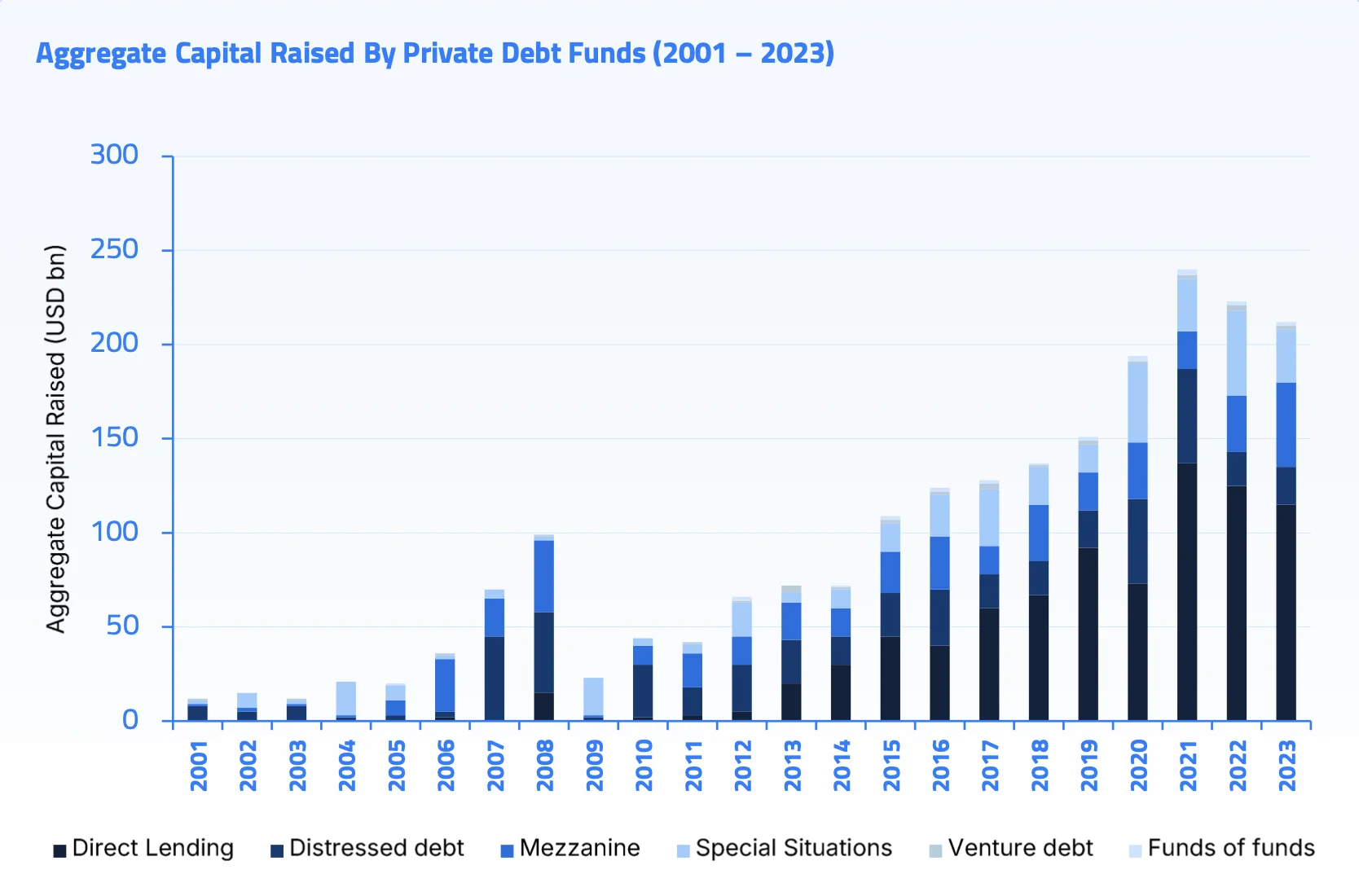
Chart 4: Aggregate Capital Raised by Private Debt Funds (2001–2023 )
Source : Preqin. Alternatives in 2025. Fig. 3.1: "Aggregate capital raised by private debt funds closed by type" (2001–2023 ).
Note: Capital -raising trends indicate investor adoption and market growth; they are not evidence of future returns. Sustained inflows can compress the pricing and weaken the terms of new lending, a dynamic documented in public leveraged finance and directionally observed in private markets .
These drivers help explain why private credit has become a durable part of the financing ecosystem . They do not, by themselves, establish that any given vintage of lending is attractively priced . Sustained capital inflows can compress spreads and loosen documentation, so the same growth that validates the asset class structurally can erode the terms available to new capital . Industry maturation, including larger platforms, broader track records, and improvements in reporting in parts of the market, has made private credit easier to evaluate and integrate into long -term asset allocation models ; but maturation is uneven across managers and segments, and general claims of strengthened under-writing standards are difficult to verify and should not be assumed . For investors who conclude that private credit merits a strategic allocation, several implementation considerations follow.
- Define the role before the size. An allocation intended as an income – oriented complement to fixed income implies a different strategy mix, and a different funding source, than one intended as a return-seeking alternative. Sizing should then be constrained by liquidity : the allocation must be consistent with the investor’s horizon, spending or liability profile, and stress -case liquidity needs, recognizing that private credit capital may be locked up precisely when liquidity elsewhere in the portfolio is scarce.
- Consider what the allocation replaces . Funding private credit from traditional fixed income increases credit and illiquidity risk in exchange for potential incremental yield ; funding it from equities reduces expected long-term growth in exchange for a more contractual return profile . Neither choice is inherently correct ; the appropriate trade-off depends on the portfolio’s existing balance of growth, income, and liquidity, and on credit exposure already held elsewhere in the portfolio.
- Evaluate concentration across managers, strategies, vintages, sectors, and geographies in the context of the investor’s total portfolio. Diversification can mitigate idiosyncratic risk, but the appropriate breadth depends on the allocation’s intended role, existing exposures, governance capacity, and access to specialist expertise . A concentrated program with strong oversight may suit one investor ; a broader program may suit another. Breadth is a design variable, not a requirement.
- Match the allocation to governance capacity . Private credit requires the ability to underwrite managers, evaluate valuation practices, monitor exposures with limited transparency, and maintain conviction through periods when reported marks and economic reality may diverge . Investors without this capacity, whether internal or through advisors, should weigh that constraint as seriously as any market risk.
Conclusions
PRIVATE CREDIT MERITS CONSIDERATION AS A STRATEGIC ASSET CLASS ALONGSIDE EQUITIES, REAL ESTATE, AND TRADITIONAL FIXED INCOME BECAUSE ITS RETURN GENERATION CAN BE STRUCTURALLY DIFFERENT:
income accrues contractually, terms are negotiated bilaterally, and much of the market operates above equity in the capital structure, in each case to degrees that vary by strategy and transaction . In portfolios whose core pillars share sensitivity to valuation and financing cycles, that difference has the potential to improve diversification and income stability in some portfolios, subject to implementation, manager selection, vintage, and market conditions . The argument is not that private credit is necessary, defensive, low-risk, or superior to public markets . Contractual seniority is not guaranteed capital protection ; lower reported volatility is not lower economic risk; illiquidity premiums are potential compensation, not assured excess returns . Nor is an allocation the default correct answer for capable investors . Even investors with sufficient governance capacity may reasonably decide against an allocation where expected net compensation is inadequate, existing credit exposure is already substantial, or liquidity constraints outweigh the potential portfolio benefits ; declining to allocate reflects a judgment about price, fit, and constraints, not a lack of sophistication For investors who conclude that the compensation is adequate and the constraints manageable, private credit can broaden the sources of return and income within a diversified portfolio . For others, the traditional pillars, complemented by public credit markets, remain an appropriate foundation.